

Understanding the situation: What’s going on here?
The growth of AI adoption depends on expanding compute power infrastructure, which requires physical data centers to be built, equipped with the latest GPUs1, and maintained. McKinsey projects $6.7 trillion in total AI infrastructure investment by 2030.
…by 2030, data centers are projected to require $6.7 trillion worldwide to keep pace with the demand for compute power. Data centers equipped to handle AI processing loads are projected to require $5.2 trillion in capital expenditures, while those powering traditional IT applications are projected to require $1.5 trillion in capital expenditures (see sidebar “What about non-AI workloads?”). Overall, that’s nearly $7 trillion in capital outlays needed by 2030 https://www.mckinsey.com/industries/technology-media-and-telecommunications/our-insights/the-cost-of-compute-a-7-trillion-dollar-race-to-scale-data-centers
From Bloomberg:
Capital expenditures from Microsoft, Alphabet, Amazon.com Inc. and Meta Platforms Inc. are expected to rise 34% to roughly $440 billion combined over the next year [2026], according to data compiled by Bloomberg. Meanwhile, OpenAI has committed to spending more than $1 trillion on AI infrastructure.
The infrastructure spending figures don’t fully capture the scale of what’s being built. The McKinsey analysis shows global data center capacity expanding from 2025 to 2030 will reach 219 gigawatts (GW) capacity with 156 GW related to AI workloads.
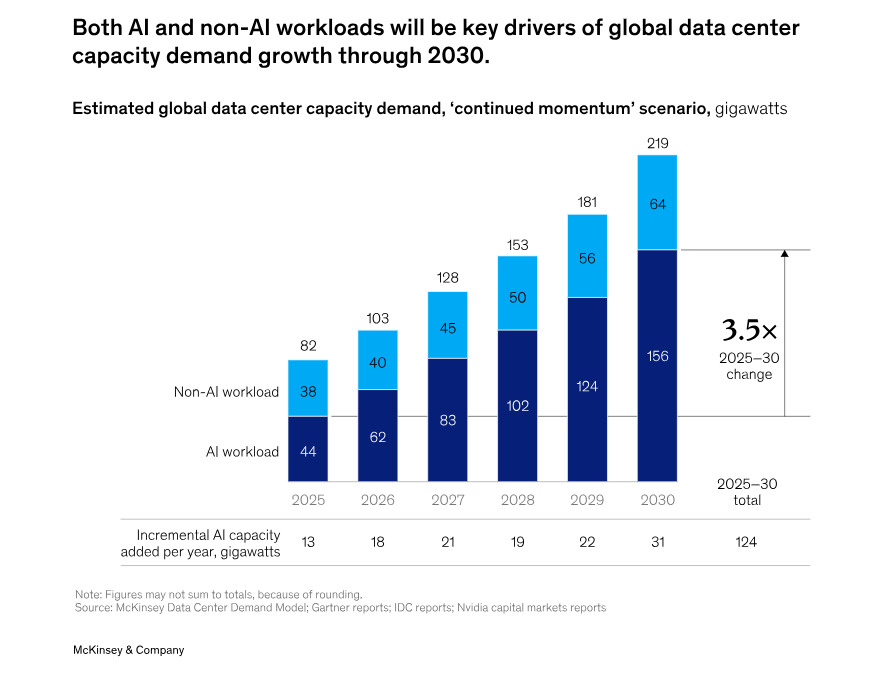
219 gigawatts is a large number. For starters, that’s 181x more gigawatts than the 1.21 gigawatts that surprised Doc Brown (in 1955). Which also sparked Marty McFly to wonder, “What’s a gigawatt!?”

To put 1 gigawatt into context:
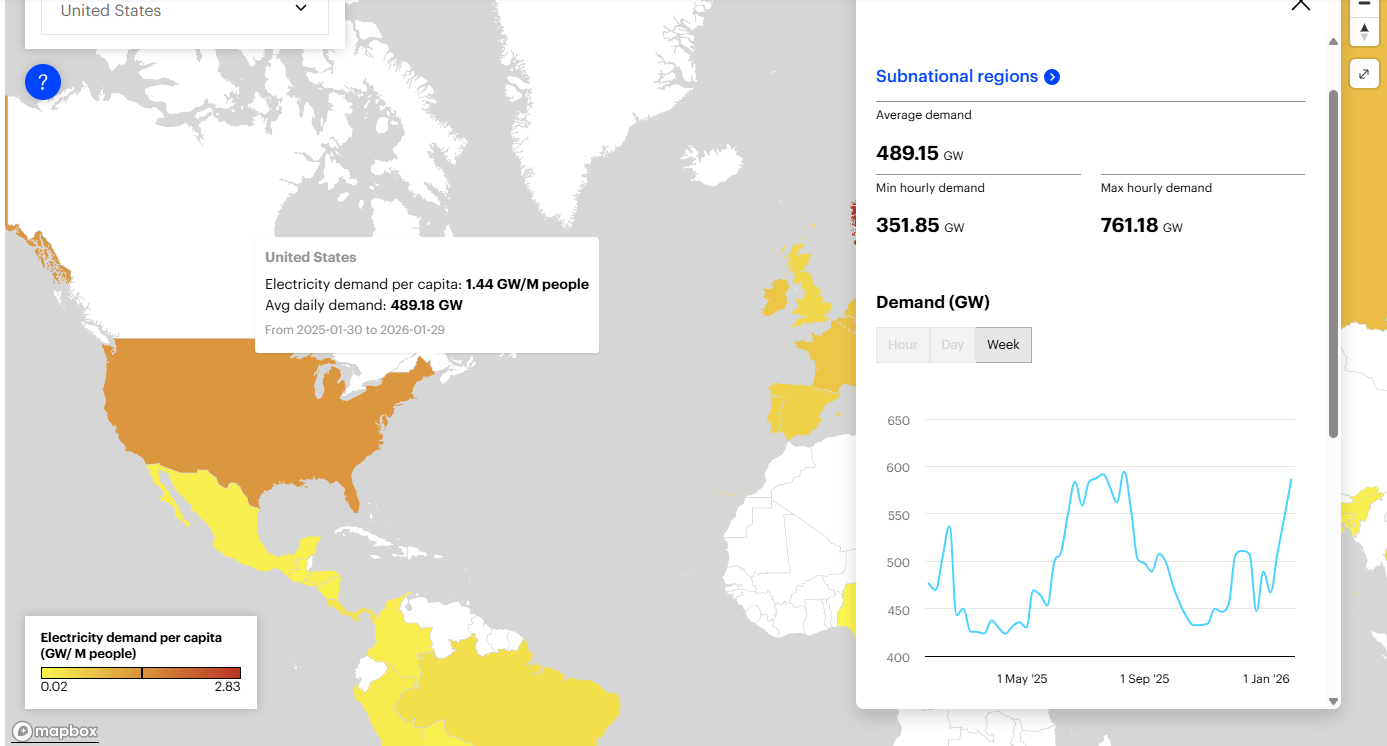
According to the International Energy Agency (IEA), over the last 12 months, the US has had a power demand between 350 and 760 gigawatts, with an average demand of 1.44 gigawatts per million people. Let’s simplify and say roughly 1 gigawatt per million people.
If you combined the average power demand of Germany, France, the UK, Italy, Spain, Sweden, and Switzerland over the last 12 months, you get 218 gigawatts.
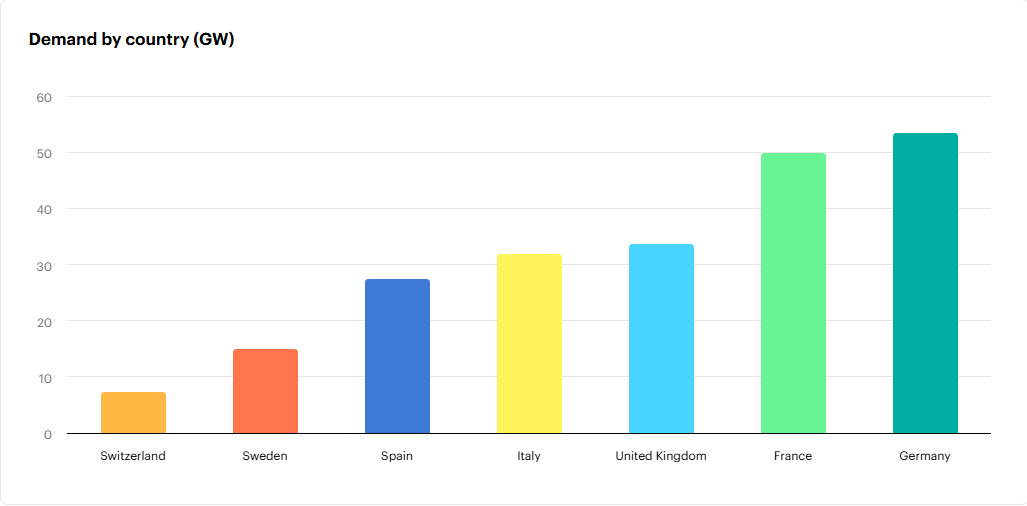

So yes, “219 GIGAWATTS!?” That’s a lot of power needed for global data centers by 2030.
This massive buildout raises critical questions: Can supply chains deliver at this pace? Will demand justify the investment? Is there an AI investment bubble?
The key investment question: Is the expansion of AI infrastructure sustainably growing?
It is unclear if this pace of growth can be achieved given supply constraints and development bottlenecks. It’s also unclear if the pace of capex2 is outpacing the near- and long-term demand. Is the capex spend replicating the pattern of fiber optics and the expansion of the web, with capex well ahead of demand, or is this time different?
Traditional fundamental research will check each set of financials as a signpost for the path ahead. They will wait for commentary from management to assess conviction or look for potential areas of concern. However, these signals only come once every 3 months from public companies.
Instead of waiting for company results to be reported and industry experts to update their forecasts, there is alternative data3 to leverage to monitor the trends with more granularity and frequency.
This article is a framework for thinking about alternative data applications in the data center infrastructure debate. We’re sharing a roadmap for how product owners, data strategists, and investors might approach this question with alt data. We are mapping out the data landscape and analytical approaches that could address these questions. It does not provide research conclusions or access to underlying datasets. Think of this as a brainstorming template you can adapt for your own analysis.
⚠️Disclaimer: This isn’t an investment research report. This article will not provide answers to the key investment question. Instead, it will help you think through the problem and run your own analytics with alternative data.
There are plenty of writers on Substack with views on the answers to these questions, including Michael Burry and Michael Spencer (and probably others not named Michael).
Use this framework run your own analytics and reach your own conclusions with alternative data.
Brainstorming Data Solutions to Address the Key Investment Question
This article is a brainstorming playbook for mapping data to sub-questions related to the key investment question. You’ll find 11 alternative data approaches to addressing this key investment question, with each section showing the more specific question the dataset type can answer, what the key metrics are, why it works, and the key caveats to consider.
Understanding data center supply:
Permit data to track construction projects before they begin
Construction progress monitoring via satellite imagery
Understanding constraints to data center growth:
Electricity capacity constraints and grid stress analysis
Water scarcity risk indicators
Understanding demand for AI:
Demand signals from cloud pricing
Demand signals from app usage
Demand signals from web traffic
Demand signals from open-source code usage
Human capital investments to support AI usage via job listings data
Understanding C-suite and budget decision-maker sentiment and intent
Corporate sentiment tracking through earnings call NLP
B2B survey methodologies for measuring enterprise AI adoption
Who can benefit from this article:
For investors and data strategists: An opportunity to compare notes on analytical approaches using this comprehensive framework covering supply, demand, and constraint monitoring.
Data vendors: this framework will show you how investors evaluate and combine alternative datasets for investment decisions. I welcome data providers to share in the comments how their data fits within this brainstorming exercise or expand the scope of brainstorming to include more related questions and how their data product fits.
Welcome to the Data Score newsletter, composed by DataChorus LLC. This newsletter is your source for insights into data-driven decision-making. Whether you’re an insight seeker, a unique data company, a software-as-a-service provider, or an investor, this newsletter is for you. I’m Jason DeRise, a seasoned expert in the field of data-driven insights. I was at the forefront of pioneering new ways to generate actionable insights from alternative data. Before that, I successfully built a sell-side equity research franchise based on proprietary data and non-consensus insights. I remain active in the intersection of data, technology, and financial insights. Through my extensive experience as a purchaser and creator of data, I have a unique perspective, which I am sharing through the newsletter.
